The Man with a Black Cap Crazy about
Stories
Raghavendra Patil
The dividing line between
fact and fiction seems too intricate to think of…. Sometimes when a story is
being told, it appears to be real and at some other times when a fact is
narrated, it sounds like a fiction. Grandfather used to make children sit by
him and narrate stories… it was like this and it was like that…. If I, who
never saw his face, make a story out of what he told them, some elements of my
own life are likely to creep into it. Just see here, note this… they would say,
and create an evidence. Instead, let us consider a real event that Basu of our
village climbed the tree in front of the temple in order to make a pole for
Hanumant Dev’s palanquin. He sat on a branch from which a swing was hanging and
began cutting the very branch off. If this stark reality is narrated…the entire
narration is sure to grow into a queer image…. They would deride it on one
pretext or another… grumble that the character lacks logical development, gaps
are not bridged and so on—and reduce Basu to a mere actor in a play. All in the
name of logic! Logic is an egg dropped into Lord Timmappa’s hundi. It is lost to me and you, worse, lost to Him too. It would never come to be hatched either. Let
it be. If you ask me why I tell all this… and if I am hatching an egg, my reply
is simply ‘yes’. If the young bird hatches out fluttering its gentle wings to
peck your head, yes, only then you say that it is a fact. Otherwise, you will
use worn out phrases like ‘growth of characters in the story… and this and that…
and peck the heads of others. Of course, you have the freedom to do so. After
all, who am I to tell you to mean something this way or that?
Coming to the point, it is
only recently that I met this chap with a black cap. I was waiting patiently
for a bus to return home at Gokavi bus stand. It was past 12 noon. The
11o’clock bus was yet to leave. When asked about this delay, a bus conductor
sitting in the controller’s cabin informed me that the 11o’clock bus had been
cancelled. I murmured to myself ‘Useless
fellows, if they can’t ply buses on time, better they be cow-herds.’ It was
then that I heard a voice coming from my side, ‘This is not a singular
instance, sir.’ I was a little startled and saw the man with a black cap
looking into my face smiling. ‘Why do you get so much upset with the
cancellation of a single bus? That is an instance of how our state is run,
isn’t it?’ He began talking in this strain….
I have seen a lot of such
people wearing coats and black caps. Usually they criticize the government and
gossip when they come across men of about thirty five to forty years of age,
clad in ironed clothes. He was perhaps one such critic. When I was about to
turn my face away from him without responding, he asked, ‘When do you have your
next bus, sir?’ ‘Next bus? I think I have to wait for the 3 o’clock Jamakhandi
bus…’ I said. The man got emboldened by my response. ‘At 3 o’clock … There’s
still a lot of time. Come on, let us sit down somewhere.’ He almost dragged me
and compelled me to sit beside him on a cement bench. On asking, I told him I
was from Kollolli. ‘Oh Hanumappa of your place is our family God… I never miss
the Kartika utsava there, sir’ he said.
I did not ask him where he belonged. It was obvious that he needed no
questions or excuses to chatter. The only thing he wanted was someone to listen
to him and hence he started unwinding the reel of words now.
He told me some odd name of a village in
Hukkeri taluk as his native place. He
told me the name of the circle and also the name of the village Sonagutti or
Monagutti nearby. ‘You must have heard the name of our village’ he said. I had,
in fact, never gone to that place. I knew nothing except the name of Hukkeri as
a taluk in Belgaum district, just as Athani and Raybag were. ‘ Oh that’s why
you don’t know me. Had you known our village, my name would have been quite
familiar to you’ he said. I grew curious. I reviewed the name of his village to
see if there was a clue to his name in it. But there wasn’t any. So I asked,
‘How is it that someone can know you if he knows your village?’ He explained,‘
Our family is very well-known not only in our village but in the neighbourhood as well. That is why Kulkarni
Shyamarao’s name is inseparable from the name of our village.’ It was how he
introduced himself to me.
After this, he posed me an
unforeseen question,‘ What about the availability of farm workers in your parts, sir?’ I was a little
alarmed at this. Probably, he needs some
farm labourers from our village, that’s why he is showering kind words on me, I
thought. Hence I gave a guarded reply, ‘There’s labour problem in our village
too. We also bring them from outside for
cutting sugarcane and working a press and things like that. We get them from
Kurabyata and Betgeri region. People migrate from there during drought, you
know.’ ‘No no, we don’t need workers’ he retorted, ‘ I enquired casually. We
have eight to ten people to do our farm work. That’s not a worry at all.’ I
asked him, surprised, ‘You have got so many labourers. How much land do you
have then?’ He started counting now, murmuring to himself. He thought of his
various fields named after different trees and different soils. At last he
arrived at the grand total of seven hundred and fifty acres. Heaving a sigh of
despair he said, ‘That’s what remains in my hands now.’
‘Remains in your
hands? What do you mean? I don’t understand’ I said. ‘That means exactly what
you criticized this government for. To tell you the fact, our family has a long
history. Vishwambar Sharma was its founder. It is believed that he belonged to Shringeri. He was a profound scholar and great ascetic. He went to Pampakshetra later.
Krishnadevaraya was ruling then.’ As he continued, I yawned in spite of me. ‘
Vishwambar Sharma had a lone son by name Vagbhushan Sharma. As the latter grew
up, there was some conspiracy in the palace. Consequently, Achutaraya came to
power. He was very sensual.
Nevertheless, he believed in religious rituals like worship, yaga, yajna
etc. He founded an endowment fund called ‘Ananda Nidhi’ in order to foster such
rituals. Our elders were intimate with him. In return for this good faith, he
granted our family jahagir of sixteen
villages in Gokak and Hukkeri taluks.’ I interrupted him, ‘That’s fine. But why
did your family choose this drought-stricken area of all? In Teerthahalli and
Shringeri , what all farmers need to do is to sow seeds in their fields, go
home to relax unworried until they come back to reap the corn finally. Instead
of choosing such a fertile land, what made them accept this barren one?’ He
felt that I doubted his words. Breathing heavily, he said, ‘See, sir, you
believe whatever I say, truth or lie. Nothing, I get nothing, to gain by
telling you a lie. Take my word for it. In fact, my elders had to accept this
barren land as a part of a plot against them. The minister and the document
writer were hand in glove with each other in this conspiracy. The minister had
a whore. The area of land set aside for us was gifted to her son and this
drought-prone land was tied to our neck. Just see the fun. Gold turns into iron
in the hands of an unfortunate fellow. Let it be, it’s all an old story. We get
what we deserve.’ He went back to pick up the story of his family.
‘It is believed that even
after receiving this gift land our ancestors continued to live in their native
place. Later, after Achutaraya’s demise, the palace was ridden with internal
conflicts. It led to a gory situation of beheading people mistaking them for
supporters of either this side or that. To crown it all, Achutaraya’s wife
wrote to Adilshah in Bijapur about this. Tired of this turmoil, our family left
the place and came over here. So far, so good. Listen to me further. After the
reign of Achutaraya, came the rule of Bijapur. It was followed by the Maratha
rule. Aurangzeb’s rule somewhere in the middle. The Peshves came later,
followed by the Company Sarkar. Despite all this, our jahagir remained intact. Sometime in the middle, the Company
Sarkar passed the Jameendari Act
making our right on the land still firmer. All those who came to power from
time to time, honoured our right. Yes, all of them. But see, what has happened
now. A government of our own people is in power today. What good has it done to
us? It says the land isn’t yours. It has passed the Tenancy Act. Now we have
our own people tearing and eating us.’
‘What were the villages given to you
as jahagir in Gokak taluk?’ I asked
him. He said, ‘Four villages – Kolavi, Benchinamardi, Hosur and Khangaon.
Cultivable land in other villages had already gone. In Kolavi, only a forty
acre piece remained. But the owner had approached the Land Tribunal. See, what wretched times have
come! If we kindly allow someone to cultivate our land on our behalf and ask him to give us only a
bit of grain in lieu of it, he would claim the entire land as his own! Of
course, I did not budge, that’s a different matter. I took a cart-load of
people and gave him threats. I caught someone to warn him that his life was
jeopardized if he earned Rao Saheb’s enmity. I managed to get the case
withdrawn by him stuffing money into his hands. Now his name is removed from
the Record of Rights. Nevertheless that dirt eating son of a bitch has again
gone to the Land Tribunal.’ Calling him names, he continued, ‘I have come here
in connection with the same case now. The bastard has failed to submit the
related documents to the court. I have tightened everyone right from the Village
Accountant to the Tahasildar. Let him moan, the wicked chap! He has taken
adjournments in the last four hearings. Let that be. He is dancing madly to the
tune of some people. He will soon be a beggar.’ Before he continued, the porter
in the bus-stand announced that the Jamakhandi bus was ready to depart. I got
up hurriedly. The man bade me goodbye saying, ‘Let us meet again.’
·
* *
In the next five to six months, I
saw the man with a black cap four or five times in Gokavi. Whether he had come
there for the tribunal work connected with the Gokavi land or to ‘tighten’ the
Village Accountant, the Circle Officer or the Tahasildar, I did not know. I was
inclined to avoid him, an heir of Vagbhushana Sharma’s clan, fearing his
torrential outpourings of words. However I was trapped one day. As I was going
out of the bus stand, he met me and saluted me. Now I realized I was caught.
Had I seen him in time, I could have avoided him. He said to me, ‘I think, you
rarely visit Gokak. After our meeting the other day, I came here several times
but I did not see you even once. Come on, our tribunal case is going to be
finally decided today. It is nice to have the company of a friend like you on
such an occasion.’
He led me to the court and soon
started looking for his lawyer. The lawyer was yet to come. ‘Our lawyer is an
expert. He has made the defense lawyer lick the grounds with a single blow of
his counter argument’ the man said. He went on applauding his lawyer’s acumen.
In the meanwhile, the lawyer came there. He had besmeared his forehead with gopichandana. He too had a black cap on
his head. As the lawyer approached, the man went a step further to wish him.
Then the lawyer went past him saying, ‘The first in the court proceedings today
is the verdict of your case.’ We followed him to the court hall and sat on a
bench. The lawyer went further and occupied a chair. The Magistrate Saheb entered the hall
in ten minutes. Somehow I had had a feeling that the Magistrate would be a man
with grey hair and grey moustache. But to my surprise, he was boy-like and a
gentleman with dark crop and clean shaven face. The whole hall gave him a standing ovation. A lawyer in black coat went to
the judge holding a file and placed it before him. He said something to the
judge in a whisper looking at the man’s lawyer from the corner of his eyes.
Nodding, the judge raised his head to see the lawyer. The lawyer stood up as a
mark of respect and sat down again. I saw the judge exchange a smile with him.
No, it may not be. We have such illusions many a time.
The boy-like lawyer who
talked to the judge then told something to the clerk too. The clerk, in his
turn, got up and told something to the Daphedar,
standing at the door. The Daphedar
wore a white shirt and white trousers, resembling a character in a play. Now
the Daphedar started calling out
names. Consequently, a few people in the hall went out and a few others came
in. The man’s lawyer and another person who moved as a viper, stood up and sat
down together to register their presence. The defense lawyer seemed to smile at
the man and salute him. The man patted on my back and introduced me to the
respondent lawyer and then told me in a whisper that he had tightened the
defense lawyer too. Meanwhile, the judge cleared his throat coughing, a little
deceptively. Those who were engaged in prating lowered their voices to a
whisper, all
of a sudden.
Even the whisper subsided gradually. Now there came the judge’s voice… the
complainant… the respondent… the witness… the panchanama… etc. Besides, he went on quoting countless sections and
rules and the man sat all ears to it. Having no knowledge of the language, I
sat there winking. Now the man jumped to his feet jubilantly, threw away the
cap and shouted, ‘Satyameva jayate.’
The Daphedar at the door, who had put
on a crown-like cap, came running in. All the lawyers in the hall got up, and
hiding a smile behind their lips, made signs to their clients to be silent. I
could know nothing, nothing of it at all and got up, bewildered. Then the man
pulled me and made me sit down with him. The judge hit his gong on the table
bringing order back to the hall. Now he resumed his speech from where he had
left it.
When the judge’s pronouncement was
over, the man’s lawyer bowed to him. Then he went to the clerk to put his
signature and told something to humour him. Now he moved towards the door with
some documents in his hands. The man asked me to follow him out of the hall. I
did so. When the man was busy conversing with some lawyers there, I came away
quickly. I felt it was the right time for me to do so. In the broad scorching
sun outside, the rocks on the Malliksab Mountain appeared more gigantic than ever.
It was indeed frightening to think they would roll down.
Even after returning home,
the man with a black cap who was queer on all counts, haunted me now and again.
For him, victory in the land dispute was as great as that in the Panipat War. I
laughed to myself whenever I recalled him proclaim in the court, ‘Satyameva jayate’ and jump and throw off
his cap. What actually was the truth? What won truly? No one knew. If he threw
away his cap and shouted like that in the court, he must be extremely
sentimental. His peculiar behaviour had been reported in the local newspaper Samadarshi. The paper smelt
intervention of capitalism in judiciary in the case. The Nirvana, another newspaper, described it under a bold headline, as
a parody of honesty. It criticized the man’s victory and the Tenancy Act too.
Ironically the paper said that the judgment brought honour to Indian legal
system which should remain like this forever. Children, roaming around idly
consequent upon their inadequate schooling, were divided on the issue. Some of
them supported the Samadarshi and
others the Nirvana. They sought my
last word on the matter, as they knew my familiarity with the man and my
presence in the court at the time of judgment. But nothing had yet settled down
in my mind. So I left them to take their own decision.
By and by, the discussion
about the man waned and his picture in my mind faded. But one morning, I was
excited to see him alight from the bus at Kollolli. I welcomed him and led him to
my house. As he sat in a chair, he remarked, ‘You deceived me the other day. In
fact, I wanted to take you to our village that day itself.’ I explained to him
that I had had some work and I could not inform him before leaving as he was
busy. He said, ‘Let it be. Today I have come here to take you home.’ What a
strange behaviour! Does he want to make me a witness in his case again? This
question crept up into my mind. I promised to come to his village some other
time. But he would not listen, ‘Oh that can’t be. I have come here just to take
you there. You must come with me now.’ In the meanwhile, my daughter came out
with a cup of tea for him. ‘Truly speaking, I have promised my family about
your visit. They will be waiting for us’ this was how he intended to trap me.
Trying not to fall a prey to it, I said in a lighter vein, ‘Why not, I will
come. I am really tired of labourers, tenancy and the like. I will come and
stay with you for four to five months and enjoy your hospitality. What do you
say?’ But he asked me seriously to give up joking and get ready to go. Though I
gave him a list of problems I had, he did not give in. He made me aboard the 9
o’clock bus with him.
·
* *
We got off the bus at a cross, two and
a half miles away from his house. Now a farm worker came running and took the
bag from his hand. He had brought a roofed cart to take us to the house. Inside
the cart, fodder bags were evenly laid and a quilt was unrolled upon them.
There were pillows to lean against. It was more comfortable to sit in the cart
than in a bus. When the cart set forth, two other farm workers followed it
closely. The mud road was dusty due to frequent movement of the cart. However
the cart did not oscillate violently but swung lightly from side to side. It
induced me to sleep but the man kept me awake. First, only barren land was seen
around. No greenery was in sight. But as we moved on, maize, grown head high, caught
my eyes on either side of the road. I had no doubt that this rich
green field belonged to the man. In our village, we moved heaven and earth and
sweat blood to cultivate a small piece of land just because the workers often played truant. It’s anybody’s
guess how he managed so vast a land here. Besides, he visited various offices
and the court in Belgaum and Gokavi almost every morning. Unable to contain my
curiosity, I asked him about this. ‘Why should I work? If the labourers come to
do my work, it means they are ready even to die for me. It is I who pronounce
the last word whether an idler should live or die.’ I shuddered to hear this.
Hence I left it at that. But he did not stop. ‘See, Lord Krishna Himself has
said that work is worship and work leads to salvation. When it is the truth,
imagine, how sinful the idlers are! To start with, I warn the idlers. If they
mend their ways, it’s well and good. Otherwise, I will send them straightaway
to God for going against His will. Am I wrong? What do you say?’ What could I say?
I sat silently. The man was in a loquacious mood. He continued, ‘Remember, what
Lord Krishna said, (when?!) Paropakarartham
idam shareeram. How long will we
survive? Not very long, isn’t it? So, as long as we live, let us help others.
Death chases us on our heels. Let us continue to help out others with our good
advice to obey God’s will. Don’t you think that Vivekananda and the like did the
same thing? They did it on a large scale because they were ascetics. We are
ordinary house-holders. All can’t be ascetics, can they? The world should also
go on, you know. Our elders have set a path for us. It is enough if we follow
it. That is the reward of this earthly life and life beyond.’ When the man, the
successor of Vagbhushan Sharma, started piling up such philosophical thoughts,
I felt I was being immersed into the water by someone pressing down my
shoulders hard.
There was a burial ground just
before we entered the village. Close by it, stood a pillar, a forlorn piece of
sculpture. It roused my curiosity at once. I asked the carter to stop and went
to the pillar in order to have a close look at it and save myself from the
man’s turbulence of words at least for some time. It was a round and intricate
pillar of about a foot diameter, an attractive and a skilled work of art. The
sculptor had carved blooming creepers and roses round it in the space, one or
two cubits above the ground. Just above that, in the second part of the pillar,
there were rows of wild pigs, buffalos and elephants. It looked as though these
animals bore the pedestal of the third part on their horns. On the frame of the
pedestal were creepers again, besides carvings of cows and bulls. Amidst them
were ploughs being drawn by bulls. On the bottom of this part, some mortals
were seen, fighting against one another with weapons. These humans bore the
next part. This part too had a carved pedestal, like the rest, on which some
humans sat in padmasana, engaged in
studies. Among them was Lord Krishna playing a flute. The face of the sculpture
covered the rest of the pillar above. Look at it whatever way or from whatever
angle you please, you could see the entire face. The sculptor’s skill was
indeed amazing. I went round the pillar and observed it keenly. The coronet,
carved above the face, suited the figure elegantly. If the ancestors of the man
had founded the pillar there, they must have been historically prominent, I
thought. What motivated them to do so? After viewing the pillar minutely once
again, I came back to mount the cart. My visit would have been certainly worth
it, had I seen only the pillar and nothing else. I wanted to know if the man
had informed the Government about it. By way of explaining, I said to him, ‘See
sir, this pillar is a historical monument. There is a department in the
Government to preserve such things.’ The man stared at me for a while and shot
back, ‘You say that I must have informed the Government about it. All right.
What would the Government people have done? They would have dug it out in the
dead of night and thrown it somewhere depriving it of any worship. But see, we
worship it on every Amavasya and Dasara. We don’t forget it under any
circumstance.’ Hearing this, I spoke of the pillar’s past and remembered to
forget its present and future. I thought that it must have been erected by one
of the man’s ancestors. (At once, I doubted my own words.) They did not even
know why they had done so. Whatever might have been its purpose, the man’s
great grandfather had made an innovative use of the pillar. If someone had done
something which the family thought was wrong, he was tied to the pillar and
whipped. On every Amavasya, a whip
was placed at the foot of the pillar and offered pooja. ‘The pillar has great power. That’s why there is peace in
our village. Of late the people around have also become its supplicants. They
beg it to free their villages from din and disorder. They come on carts to
worship it on Pournami and Amavasya’. While the man was elaborating
the story, some people came from the village side dragging an old woman. The
moment she saw our cart, she wriggled herself free and fell to the ground
weeping. One of them came very close to the cart and reported to the man that
the woman had stolen a few maize spikes from his field. The old woman
managed to be in the man’s view and prayed to him beating on her chest, ‘O father, you are my
God. My grandson had had no morsel for two days. My heart couldn’t bear this.
In order to save him, I plucked only two maize spikes. Please forgive me.’ She
prostrated on the ground. The oxen retreated a step or two, swiftly. The man
was unmoved and asked the carter to move on. Someone dragged the woman away and
the cart went on. She tried to follow it bewailing. The man’s people pushed her
away. When I looked at the man’s face, he said, ‘Discipline is discipline. It
is wrong to break rules. The Company Sarkar should have hanged those who had
gone on strike and broken rules on the pretext of freedom. Had it hanged those
braggarts who shouted ‘we would do this, and we would do that’, people would
have been loyal dogs by this time. As the Sarkar had failed to do so, the
country was mortgaged to such sinners. It ruined itself and ruined people like
us too!’ By now the cart came through the village and finally stopped in front
of the man’s house. The carter descended and unyoked the oxen. The man got down
and led me into his house.
The mansion in which the man lived
resembled a fort. As we entered the threshold, a boy and a girl came jumping
about and shouting, ‘Oh father came, our father came!’ He gave them a packet of
sweetmeat from his bag. I asked him if they were his niece and nephew. He replied,’ No, no, they
are my own children, by my younger wife.’ Then he took me into the hall. The
hall was laid with quilt, and cushions were placed all along a wall to lean
against. A large cushion, lying at a particular place, had made the place
conspicuous. The man removed his shirt and coat and hung them on the hooks.
Then he showed me to the bathroom in the house yard to have a wash. There was a
maid servant in the bath room preparing hot water for bath. She gave me
lukewarm water from a large copper pot. As I finished washing, another servant
came in hastily to provide me with a towel. I returned to the hall and sat
leaning against a cushion. Some photos of Vithal- Rukumayi and some possibly of
the man’s parents were stuck on the door-frame. On all the four walls of the
hall, not too high, were hung framed paintings. I appreciated his taste and
started observing them. One of them was especially spectacular – bees are
invading a woman… she stands in a scared stance stretching her arms out to shoo
them off… her alarmed look, rich bosom, her simple dress like a house
maid… – all, all captivated my mind. As
I was observing it keenly, the man came there. I asked him if they were
Ravivarma’s paintings. With a boisterous laughter he said, ‘I would have said
‘yes’, had someone else asked me this question. But you are asking it. To tell
you the truth, they are not Ravivarma’s but Talwar Kencha’s. Son of a bitch,
Kencha has a deft hand. He draws a line and it’s over. Never does it need to be
mended.’ I was really baffled. Requesting me to take my seat, the man gave me a
glass of lemon juice. He too sat down leaning against a pillar. I drank the
lemon juice draught by draught, as if to abate the fire of surprise in my mind.
The man came again and stood close to me. He must be watching the same picture
as I did – a large colourful building… around it, a hen, with its young ones,
is busy scratching the dunghill; above, a little above the building, in the
air, an eagle is floating… etc. I told the man that in case Talwar Kencha had
pursued the art, he would have been a great artist. He retorted laughing,
‘There’s no school in this village, saheb. The government has, of course,
started one now. But no one has bothered to send his children to this school.
Tell me, what do they get from schooling children. How should the social system
work if all children go to school?’ I was totally speechless at it. He came
still closer to me and said, ‘Saheb, I ask you one thing, don’t mistake me.’
There was a severe demand in his eyes. He went on, ‘You are a story-teller and
novelist, aren’t you?’ I could not help laughing and asked him, ‘What is there
to mistake you? I occasionally scribble something, it gets printed in the Samadarshi and other local papers.
That’s all. There is nothing special about it, sir.’ ‘No no, I mean, you… you please write my
story and the story of our family including the peace prevailing in our
village.’ He looked very humble. Even
when he had seen the old woman being man-handled by his own people, he was
unmoved. But now he was over charged with emotion. It touched me somehow. I
stopped laughing abruptly and promised him to write his story at an appropriate
time. He seemed to be gratified and requested me to relax till lunch was ready.
·
*
*
After lunch, when we were
sitting with a plate containing bêtel nut and betel leaves in front, the
attendant came in to inform the man that Kamatar Chennappa was waiting outside
to meet the latter. The attendant believed that Chennappa must have come in
connection with his son’s marriage. Hearing this, the man was thoughtful for a
moment. And then as though something had dawned upon his mind, he asked his
attendant to show Chennappa in.
Reclining on a staff, Chennappa
entered the hall and bowed to the man. When the man enquired him about his
health, he replied, hesitant and his body shrunk, that the man could see it for
himself. Then he sat at the other end of the hall. Staring at me, he asked the
man whether I was the latter’s relative. As if he was waiting for the question,
the man said promptly that I was a great man from Kollolli near Gokavi, an author of big books and my name and writings
often appeared in newspapers. Chennappa
had no doubt now that the guest was really a great man, beyond his estimation.
It was clear that he was in a dilemma of how he should honour me. At last he
bowed to me from where he was sitting, till his forehead touched the floor. As
I said ‘no no no’ to register my dissent to it, the man intervened to say that
it was Chennappa’s duty to honour me. He also told Chenna that I had consented
to write the story of his family and it was the fact that prompted me to visit
the village. I was nonplussed at this. Chennappa was glad and wanted me to
write it aptly. Then he said to the man, ’I hope you’ve told him how you got
the shop-keeper Kuber murdered and things like that, haven’t you? My name also
comes to lime light with it, as a strand does with flowers. By the way, the
Helavas of Lokapur must have preserved the story of your valour, haven’t they?’
The man turned to me and recounted the episode, ‘ Sir, here in our village, a
boy called Kubera had once been running a shop. As he went on minting money, he
began floating in the sky. The villagers tolerated him until he dared to speak
against me. When this slip of a man humiliated me, the father of the village,
people like Chenna were extremely hurt. They said they would finish him. But I
told them resolutely that my heart would bleed to kill a son of our village.
However the people were too hurt to oblige me. In the next eight days, they
dragged him out of his shop and hacked him.’ I wanted to know if the accused
were imprisoned. Chennappa proudly declared that when the man was with them,
such a possibility was ruled out. According to the man, what the people did was
the collective reaction of the whole village. Consequently, the case was
dismissed in the lower court itself for want of witnesses. The man ended the
story saying ’Oh it’s an endless Ramayana. Let it be’. Then he attended to
Chennappa and asked him what had brought him there. Chennappa said, ‘ As you
know, Dhani, my son is already grown
up. So last Saturday, I waited for Lord Hanumanta’s oracular gesture to know
the prospects of my son’s marriage. But, as you know, our Hanumappa is usually
slow and sluggish in such matters. He grants our wishes only after considering
their pros and cons. Not far from me in the shrine, the Kaktes too had been
waiting for some oracular advice for days. But all in vain. Fortunately,
Hanumappa granted. Even if I it to me without delay this time. That’s why I have come here to beg for
your help die, my son would repay your money by serving you. Please, do this
much for us.’ He bowed again till his forehead touched the floor. The man
became a little pensive now and said, ‘See Chenna, these days money is a
problem to me also. The court case and other matters swallow up my money.’
Chenna folded his hands and insisted again, ‘ Please, don’t say so Dhani , We depend solely on you. I pray,
don’t you let us down.’ After this tug of war between them, when the man
promised to consider his plea, Chenna prostrated at his feet. The man advised him not to bring home a city
bride as the city girls were adamant and averse to household work. Chenna made
it clear that he was yet to choose a bride, and if Hanumappa and the man were
gratified, getting a good bride would not be a problem. Then he left the place
after saluting both of us again. The man asked me to relax for a moment and
went in.
The paintings of Talwar Kencha,
the sight of the lone pillar and the story of murder told by Chennajja split my
mind to pieces. I tried to sleep, often changing sides, in vain. At about five,
the man came out. We had tea. Now he liked me to accompany him around the
village and through his farm which he felt would be useful to me to write his
story. His unfailing faith that I would write it surprised me. Mulling over
this, I had my shirt and coat on. Then I said smiling, ‘Let us think about
writing the story later. That’s not very important. When I have come here from
a far off place, how can I miss seeing your fields and farming?’ To this he
shot back, ‘No no, writing the story is also equally important.’ Not willing to
argue with him, I ended it at that.
It was not an easy task to
take a round in his land. So vast was it. We wandered till the sunset. Then we
returned home. In every farm, two men and four or five women were working. When
they heard their master’s voice, their throats used to dry up and they used to
tremble. If he called out a name, the worker would come up, stand before him
crouched, nod to his words humbly and go away when asked. The scene brought to
my mind the workers in my own village who would be submissive while borrowing
money but rude thereafter. I began to doubt whether these people – who
stretched their arms for his alms so slavishly and bore punishment so meekly –
were human beings at all. He was callous and imposing. He put the whole
responsibility on them while going out every morning. But for their loyalty, he
would have realized what it meant to manage so big a property. I said to him,
‘You are lucky to have such good workers. Our workers, you know, make us shed
tears.’ ‘Send them to me. I would tie them naked to our pillar of justice,
bathe them with boiling water and whip them so that they turn over a new leaf.’
His words made me really apprehensive. After this, whenever I happened to meet
his workers, I observed them keenly. Who knew whether their skin was intact
or…?
·
* *
After dinner, we sat
conversing, with a betel nut-betel leaves plate in front of us. He was all the
while reminding me of writing his story. His craze about being a story himself
was inexplicable and mysterious. He informed me of his visit to Belgaum the
next morning before I would get up. Now he showed me to a bedroom and went in to his own. I was worried about his
silence on my return journey. However I was sure he would take care of it. The
bedroom was richly furnished – the cot, the bed, the man-size mirror on the
right side, varied exotic paintings, probably Talwar Kencha’s creations, hung in lines on all the four walls. It
caught my attention indeed. When I was almost lost in it, I heard somebody call
me, ‘Saheb sir’ from behind. A woman farm- worker stood there shyly. When I
asked her what the matter was, she raised her head. I could see her seductive
wide eyes now. Before I fell into the dirt of her sight, she blushed gracefully
to inform that her master had sent her to massage me. I stared at her dismayed.
Around her long neck was mangalasutra.
I turned to the wall, and modulating my voice, asked her to leave. There was no
sound for a moment. I turned back to see her still standing there, nailed to
the spot. I repeated my command. But she told me that the man would skin her
alive if she failed to do the job assigned to her. I promised her to manage
him. Then she moved out gingerly.
I closed the door. The paintings
hung on the walls seemed to grin at me. I put out the big lamp and left the
small one burning. In the feeble light, even the painted walls looked pale. I
covered myself with the rug. Even the soft bed and the fleece-like rug failed
to elate me. Changing sides over and over again, I fell asleep at last to see
an eerie dream – the bed I slept in, the cot, the paintings on the walls, even
the doors, the paths to the fields and the fields themselves – all, all were
being snatched away one after another by some people. The whole house was
emptied! I felt cold, the rug had slid. I stretched my legs and felt for the
rug. Something pricked my leg and I woke up, terrified. There was no cot, no
bed, no paintings, no walls, no house, nothing. Everything had disappeared. I
was sitting on a stone slab inside the desolated walls. All around were burial
places, grave, raised seats, blue sky above, and in the West, the rising…. I
started running unmindful of pebbles and thorns, shrieking ‘ O mother, o
mother!’ When the gloom melted away and the pale dawn was in sight, I ran and
ran, without caring for light or darkness, path or street, pain or fatigue. I
ran, ran and ran.
Nearby was a village. Someone
going out for call of nature saw me running recklessly as the wind. He shouted
at me to know who I was and why I had been running like that. He stopped me by
stretching his arm across my path. My legs were unsteady and I sank there.
Without a second thought, he made me drink the water he was carrying. Then he
held my arm and lifted me, walked me to a temple not far away. He made me sit
on a platform there. Those who had seen the scene rushed to the temple. They
were eager to know who I was and what was wrong with me. On being insisted, I
pointed to the direction from which I had come running. I told them that some
landlord had taken me to his house and his house was in ruins by morning. In fact, I shivered to recall this event.
They whispered among themselves about the landlord and said, ‘Oh, this man is
panicky. He needs to be given God’s
prasaadam.’ Someone brought angara
and applied it to my forehead. An old man came close to me, and staring into my
face, asked me if I was a story-teller.
His question, at once, reminded me of the man who had asked me to write
his story. It shook me to the roots. I sat looking at his face.
Translated
by V N Hegde from the Kannada original, “Kathe Huchina Kari Toppige Raaya,”
Thudiyembo Thudiyilla, 2009.
Glossary :
Hundi = a donation box
Kartika utsava = a festival held in the Hindu month
of Kartika
Jahagir = a land granted as a
gift (gift-land)
Gopichandan = sacred soil borne
on forehead and on body by Vaishnavas
Daphedar = the head constable
Panchanama = Preliminary
recording of the situation in presence of elders
and sarpanch
Amavasya = the new moon day
Pournami = the full moon day
Dhani = master
Angara = sacred ash borne on the
forehead
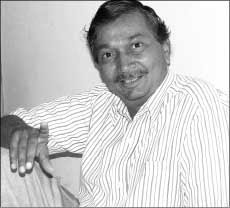
Patil, Raghavendra. A retired Biology Professor, a frontline fiction writer in
Kannada with four collections of stories and two novels to his credit. He is a
recipient of the central Sahitya Akademi Award
for his novel Teru and the
Karnatak Sahitya Academy Award for his collection of short stories, Mayiya Mukhagalu and Teru, and several
other honours. His writings are purely native in language and content. He is the editor of the Kannada literary
bimonthly, Samaahita brought out from Dharawad.
Add: Raghavendra
Patil, ‘Mayi’, 8th Cross, Kalyananagara, Dharawad – 580 007
Phone : 0836 – 2444553 Mob.: 94804 55604
Hegde
V. N. A retired English Professor, a short story writer and translator.
Published a short story collection in Kannada. Translated the monograph, Mahamahopadhyaya Gopinath Kaviraj from English into
Kannada for the central Akademi and a
number of short stories and articles
from English into Kannada and vice versa for various magazines. Add : 187, Kapila, Hoysala Nagar,
Dharwad – 580 003, Karnataka. Mob.
9844284327. Email. gangaa.hegde@gmail.com


No comments:
Post a Comment